


When someone asks about the best anxiety treatment, I usually hear more than a practical question. I hear the fatigue that comes from trying to manage worry for a long time. I hear the frustration of doing everything “right” on the outside while feeling tense, distracted, or overwhelmed inside. Many people who begin looking into anxiety treatment are not looking for a perfect answer. They are looking for a way to feel more steady in their own life.
In my experience, anxiety rarely shows up in only one way. For one person, it may look like panic, racing thoughts, or a body that never fully settles. For another, it may look like perfectionism, irritability, avoidance, or difficulty saying no. Some people become very productive because of anxiety. Others feel frozen by it. Many go back and forth between both.
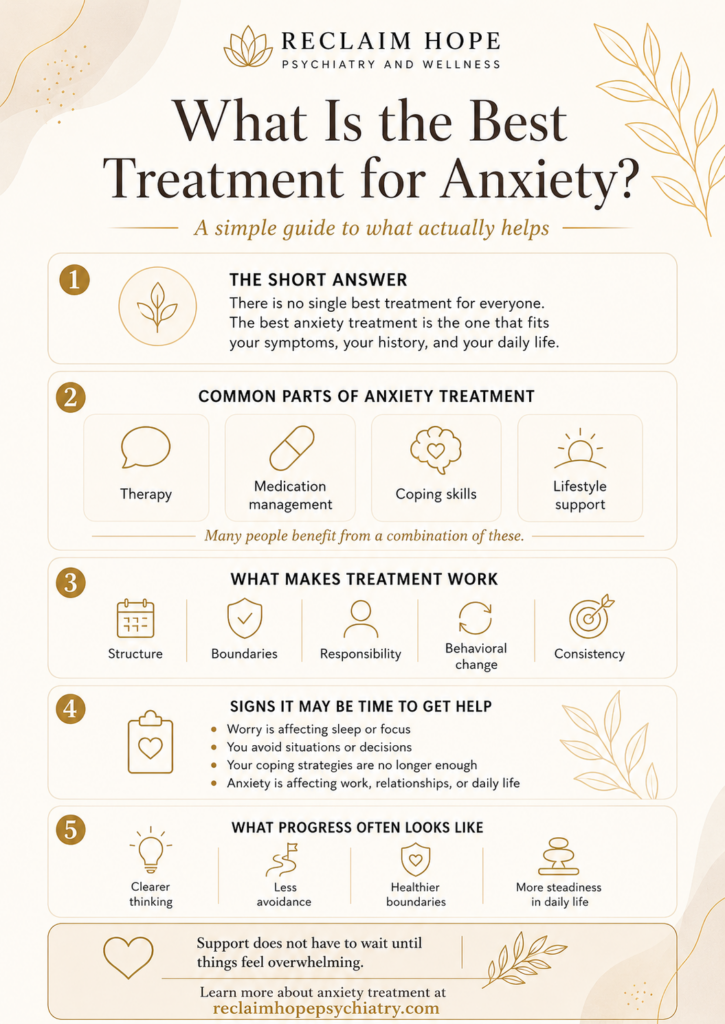
That is why the “best” treatment is not always a single method. The best treatment is usually the one that fits the person, the pattern, and the life they are trying to build.
Why There Is No One Best Anxiety Treatment for Everyone
I have learned over time that people often want a clear answer because anxiety itself can feel so unclear. They want to know whether they need therapy, medication management, lifestyle changes, trauma-informed care, or a specific type of therapy. Those are fair questions.
There are several evidence-based approaches that can help with anxiety. Cognitive behavioral therapy can help people notice and change patterns in thinking and behavior. Psychodynamic therapy may help uncover the deeper emotional roots of anxiety, including old relational patterns, fear, guilt, or responsibility that has become too heavy. EMDR may be useful when anxiety connects to trauma, distressing memories, or experiences the body still reacts to as if they are current.
Other approaches may focus on nervous system regulation, mindfulness, emotional regulation skills, communication, or practical changes in daily routines.
In real clinical work, I do not usually see healing happen because one method sounds impressive. I see progress when the treatment is thoughtful, consistent, and honest. A person needs enough structure to stay focused, enough safety to be truthful, and enough accountability to begin changing the patterns that keep anxiety going.
Therapy should not feel like someone is forcing a formula onto you. It should feel like a process that takes your real life seriously.
What Makes Anxiety Treatment Effective in Practice
A strong treatment plan for anxiety usually involves more than talking about symptoms. Talking matters, but the goal is not only to describe anxiety. The goal is to understand how it functions in your life and begin practicing something different.
That work often includes structure, boundaries, responsibility, behavioral change, and consistency.
Structure
Anxiety can make everything feel urgent. It can pull attention in many directions at once. Therapy provides a place to slow the process down and organize what is happening.
In a structured treatment process, we look at the patterns. When does anxiety show up? What does it ask you to do? What do you avoid? What do you over-control? What situations make you feel responsible for more than your share?
Structure helps because anxiety often thrives in vague, repetitive loops. When we name the loop, we can start working with it more clearly.
Boundaries
Boundaries are a major part of anxiety treatment. I often see anxiety in people who are highly responsible, thoughtful, and aware of others. These can be strengths. But when they are not balanced with boundaries, they can become exhausting.
A person may say yes too quickly, overexplain their decisions, monitor other people’s moods, or feel guilty for needing rest. They may have trouble separating care from responsibility.
Healthy boundaries do not remove kindness. They help make kindness more sustainable.
In therapy, boundaries are not treated as a personality trait you either have or do not have. They are a skill. They can be practiced. They can become more natural over time.
Responsibility
This part of the work can feel uncomfortable at first, but it is important. Anxiety is not your fault. Still, treatment often asks you to notice where your choices may be maintaining the pattern.
That may include seeking reassurance repeatedly, avoiding hard conversations, delaying decisions, trying to control other people’s reactions, or ignoring your own limits until your body forces you to stop.
Responsibility in therapy is not about blame. It is about agency. It is the moment when a person begins to see, “I may not have chosen this anxiety, but I can participate in changing how I respond to it.”
That shift matters.
Behavioral Change
Many people understand their anxiety long before they change their relationship with it. Insight is helpful, but it usually needs to be paired with action.
Behavioral change may include practicing direct communication, reducing avoidance, creating more predictable routines, setting limits with work, improving sleep habits, or learning grounding skills that can be used outside of therapy.
Sometimes the change is very small. You pause before sending the extra text. You go to the appointment you wanted to cancel. You say, “I need time to think about that,” instead of answering immediately. You stop explaining a boundary after you have already stated it clearly.
These are not dramatic moments. But they are often where treatment begins to become real.
Consistency
I have learned that consistency is one of the most underrated parts of anxiety treatment. People often want relief quickly, which makes sense. Anxiety is uncomfortable. It can interfere with sleep, relationships, work, and health.
But lasting change usually comes through repetition. Showing up. Practicing between sessions. Looking honestly at what happened during the week. Returning to the work after a setback.
Consistency helps the nervous system and the mind learn that a different response is possible.
Therapy as a Foundation for Anxiety Treatment
For many people, therapy becomes the foundation of anxiety treatment because it gives them a steady place to understand the pattern and practice new responses. Individual therapy can be especially helpful when anxiety is connected to personal history, relationships, work stress, trauma-informed care needs, or long-standing patterns of over-responsibility.
In therapy, the work is not only about symptom reduction. It is also about helping a person become more connected to their own judgment.
Anxiety often makes people distrust themselves. They may check, ask, replay, compare, or search for certainty. But life rarely gives complete certainty. Therapy can help someone build enough internal steadiness to make decisions without needing every possible outcome resolved first.
That does not happen all at once. It comes through practice.
A person may begin by noticing anxiety sooner. Then they may begin naming what is happening. Over time, they may begin responding differently. That is meaningful progress.
When Medication Management May Be Part of the Plan
For some people, medication management can also be an important part of anxiety treatment. It may help reduce the intensity of symptoms enough for therapy and daily coping skills to feel more accessible.
I do not see medication as a sign of weakness. I also do not see it as the only answer for everyone. It is one tool that may be appropriate depending on the person’s symptoms, history, health needs, and goals.
Some people benefit from therapy alone. Some benefit from medication management and therapy together. Some need a treatment plan that also addresses sleep, stress, trauma-informed care, emotional regulation skills, or life transitions.
The best care is not about pushing one path. It is about looking carefully at what is needed and adjusting with care.
Signs That Your Current Coping Strategies May Not Be Enough
Many people live with anxiety for years by developing coping strategies. Some of those strategies may have helped at one time. Staying busy may have helped you avoid feeling overwhelmed. Over-preparing may have helped you feel safer. People-pleasing may have helped you avoid conflict. Controlling details may have helped you get through uncertain seasons.
The question is whether those strategies are still helping or whether they are now costing too much.
It may be time to consider more support if anxiety is affecting your sleep, your relationships, your work, your parenting, or your ability to rest. It may also be time if you feel stuck in the same cycle even though you understand why it is happening.
I often hear people say, “I know what I should do, but I can’t seem to do it.” That is a good reason to seek help. Therapy can support the gap between knowing and practicing.
Anxiety can also become more difficult when it is hidden. People may appear calm while internally carrying a constant sense of pressure. They may be dependable, high-functioning, and well-liked, but privately exhausted.
You do not have to wait until everything falls apart before asking for support.
What Progress Often Looks Like
When anxiety treatment is working, progress is not always loud. It may look like a little more space between a trigger and a reaction. It may look like sleeping better, communicating more clearly, or noticing when you are about to fall into an old pattern.
Sometimes progress looks like saying no without overexplaining. Sometimes it looks like doing something while anxious instead of waiting to feel completely calm. Sometimes it looks like letting someone else be disappointed without taking full responsibility for their feelings.
I often see people develop more agency. They begin to understand that anxiety may still appear, but it does not have to make every decision.
Routines may become steadier. Relationships may feel less driven by fear. Work may feel more manageable because the person is no longer trying to carry everything at once. There may be more honesty about limits and more trust in small, consistent choices.
These changes matter because they affect daily life. Anxiety treatment is not only about feeling better in a therapy session. It is about living with more clarity and less avoidance outside of it.
Accountability and Maintenance Matter
One of the most helpful parts of therapy is having a place to stay accountable to your own growth. Not in a harsh way. In a steady way.
Anxiety can pull people back into familiar habits, especially during stress. A person may return to overthinking, withdrawing, overworking, or trying to manage everyone else’s comfort. This does not mean therapy is failing. It means the pattern is being noticed again, and there is more work to do.
Maintenance is part of treatment. It helps people keep practicing the skills they are building. It also helps them adjust when life changes.
In my experience, long-term resilience comes from learning how to return to yourself. You may still have anxious days. You may still face uncertainty. But you can learn to respond with more steadiness, more responsibility, and more care for your own limits.
That is different from trying to eliminate every uncomfortable feeling. It is more honest than that.
Choosing the Right Anxiety Treatment for You
The right treatment should help you feel understood, but it should also help you grow. It should give you space to speak honestly, while also helping you look at the patterns that keep anxiety active.
A good starting point is to ask what anxiety is interfering with most. Is it sleep? Relationships? Work? Decision-making? Boundaries? Your ability to rest? Your sense of trust in yourself?
From there, treatment can become more specific.
For some people, the first step is learning coping tools. For others, it is understanding deeper emotional patterns. For others, it is processing trauma-informed care needs or addressing avoidance. Many people need a combination.
The best anxiety treatment is not always the one that sounds the most advanced. It is the one you can stay engaged with, the one that helps you practice real change, and the one that respects your full life.
At Reclaim Hope Psychiatry and Wellness, anxiety therapy is approached with care, structure, and respect for the pace of meaningful change. If anxiety has been taking up more space than you want it to, you can reach out to Reclaim Hope Psychiatry and Wellness to begin the conversation.