


Depression is one of the most common conditions I see in my practice, and almost every person who comes in asks some version of the same question: what actually works? If you’ve been searching for the best therapy for depression, the honest answer is that it depends, and that’s not a cop-out. It’s the foundation of good psychiatric care. Depression presents differently in different people, and the most effective treatment is almost always a combination of approaches tailored to the individual sitting in front of me.
Key Takeaways
- Depression is highly treatable, but no single therapy works for everyone. Treatment needs to match the person, not just the diagnosis.
- Psychotherapy and psychiatric medication often work best together rather than as either-or choices.
- Warning signs of depression go beyond persistent sadness and include physical symptoms, cognitive changes, and social withdrawal.
- A thorough psychiatric evaluation is the starting point for building any effective treatment plan.
- Your role in treatment matters. Asking questions, tracking symptoms, and communicating openly with your provider all shape outcomes.
How Therapists and Psychiatrists Approach Depression Treatment
When someone comes to me reporting symptoms of depression, I’m not looking for a single answer. I’m building a picture. How long have symptoms been present? How are sleep and appetite? Is there a family history of mood disorders? Has anything been tried before, and how did it go? All of that context shapes what we decide to do together.
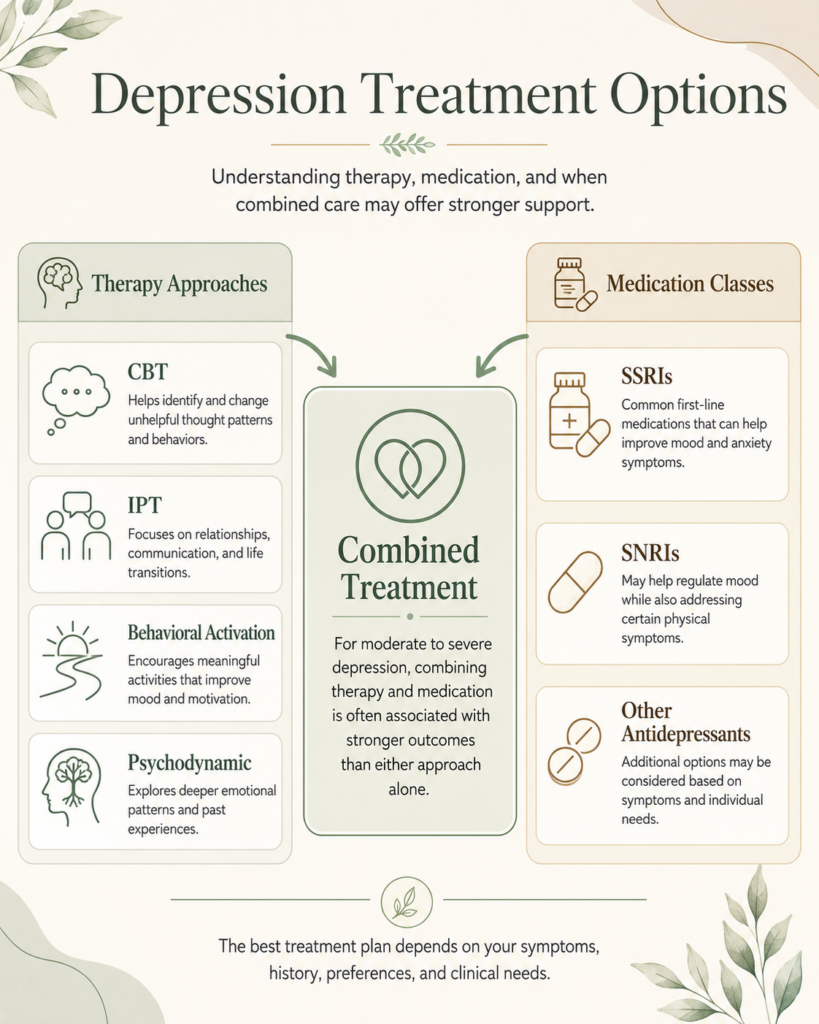
The major evidence-based therapy options for depression include:
- Cognitive Behavioral Therapy (CBT): One of the most researched psychotherapy models for depression. It focuses on identifying and shifting distorted thought patterns and unhelpful behaviors. Many people see meaningful improvement in a structured, short-term format.
- Interpersonal Therapy (IPT): Focuses on relationships, life transitions, and grief as contributors to depressive episodes. Particularly useful when depression is tied to a specific life event or relationship dynamic.
- Behavioral Activation: A component within CBT that targets avoidance and withdrawal. The idea is that depression often leads us to stop doing the things that give us a sense of purpose or pleasure, and that re-engagement can shift mood over time.
- Psychodynamic Therapy: A longer-term approach that explores how past experiences, patterns, and relationships contribute to current struggles. Not always a first-line recommendation, but valuable for certain presentations.
- Medication-Assisted Treatment: Antidepressants, mood stabilizers, and other psychiatric medications are often a central part of depression care, particularly for moderate to severe presentations. More on this below.
No single modality is universally superior. Research consistently shows that combining therapy with medication tends to produce better outcomes than either approach alone, especially for people with significant functional impairment.

The Role of Psychiatric Medication in Depression Treatment
This is where I spend a lot of time in clinical conversations, because medication is frequently misunderstood. Some people come in hoping to avoid it entirely. Others come in expecting a prescription to be handed over at the end of the first visit. The reality is more nuanced than either picture.
Medication decisions in depression are based on a careful evaluation of the full clinical picture. The class of medication recommended, how it’s introduced, and how it’s monitored are all individualized choices. Selective serotonin reuptake inhibitors (SSRIs) are often a starting point for depression because of their safety profile and decades of research behind them, but they aren’t the right fit for everyone. Some people do better with serotonin-norepinephrine reuptake inhibitors (SNRIs). Others may benefit from different classes of antidepressants based on specific symptoms, medical history, or prior treatment responses.
What I always tell patients: medication is not a decision we make once and forget about. It’s an ongoing process. We monitor for response, watch for side effects, and adjust as needed. I’ve worked with people who found meaningful relief on the first medication we tried. I’ve also worked with people whose treatment required more iterations before we found what worked for them. Both are normal parts of the process.
Medication paired with individual therapy tends to outperform medication alone. The therapy builds skills and addresses root patterns. The medication can reduce the severity of symptoms enough to make therapy more accessible and effective.
“The goal of medication isn’t to change who you are. It’s to reduce the weight enough that you can do the work, live your life, and feel like yourself again.”
5 Warning Signs of Depression to Know
Depression doesn’t always look like sadness. I often have patients who come in saying they don’t feel sad, they feel nothing, or they feel irritable, or they feel exhausted all the time and can’t explain it. These are all valid presentations. The five warning signs I watch for most closely include persistent low mood or emotional numbness lasting more than two weeks, significant changes in sleep or appetite, withdrawal from relationships and activities that used to feel meaningful, difficulty concentrating or making decisions, and feelings of hopelessness or worthlessness that don’t seem connected to any specific event.
If several of these are present together, that’s worth taking seriously, and it’s worth talking to someone.
Ways to Support Your Mental Health Alongside Treatment
Treatment doesn’t only happen in a clinical setting. What patients do between appointments matters. Five areas I regularly bring up with people managing depression include consistent sleep routines, physical movement (even short walks have documented effects on mood), reducing alcohol and other substances that can worsen depressive symptoms, social connection even when it feels counterproductive, and practicing small meaningful activities each day rather than waiting to feel motivated before acting. Motivation in depression often follows action rather than preceding it.
Finding the Right Starting Point
If you’ve been living with low mood, fatigue, hopelessness, or other symptoms that feel like more than a rough patch, a psychiatric evaluation is the right first step. Not because it locks you into anything, but because it gives both of us the information we need to make good decisions. I ask careful, thorough questions about your history, your current functioning, your goals, and what you’ve already tried. Some providers use structured screening tools as part of that process. The evaluation shapes everything that follows.
The best therapy for depression isn’t a single modality or a specific prescription. It’s a plan built around you, revisited and refined over time, grounded in evidence and in an honest ongoing conversation between patient and provider.
If you’re ready to take that first step, I invite you to schedule a psychiatric evaluation at Reclaim Hope Psychiatry and Wellness. We’ll start by listening, and go from there.
Frequently Asked Questions
What is the 3 3 3 rule in therapy?
The 3 3 3 rule is a grounding technique sometimes used in therapy, particularly for anxiety that can accompany depression. It involves naming three things you can see, three sounds you can hear, and moving three parts of your body. It’s designed to interrupt rumination and reconnect you to the present moment. It’s a useful in-the-moment tool, but it works best as part of a broader therapeutic framework rather than as a standalone strategy.
What are the 11 questions for depression?
You may be thinking of the PHQ-9, a nine-question screening tool widely used by clinicians to assess depression severity, or expanded versions sometimes used in research settings. These questionnaires ask about low mood, sleep changes, energy, concentration, appetite, and other core symptoms over a defined time period. They’re not diagnostic on their own, but they help providers track symptom patterns and monitor treatment response over time.
What are 5 warning signs of depression?
The five I pay closest attention to are persistent low mood or emotional numbness lasting more than two weeks, significant shifts in sleep or appetite, withdrawal from relationships and previously meaningful activities, difficulty concentrating or making decisions, and feelings of hopelessness or worthlessness that feel disconnected from circumstances. Physical symptoms like unexplained fatigue or body aches are also common and often overlooked. If several of these are present, it’s worth speaking with a provider.
What are 5 ways to improve mental health?
From a clinical standpoint, five practices with real evidence behind them include maintaining consistent sleep and wake times, engaging in regular physical movement, limiting alcohol and substances that worsen mood, prioritizing social connection even in small ways, and taking part in activities that feel meaningful or purposeful rather than waiting for motivation to arrive first. These support treatment but are not replacements for professional care when symptoms are significant.
Is medication always necessary for treating depression?
Not always. Mild to moderate depression sometimes responds well to psychotherapy alone. However, for moderate to severe depression, or for cases where therapy alone has not produced sufficient improvement, medication is often an important part of the picture. That decision is made individually based on a full evaluation of symptoms, history, and personal goals. It’s not a one-size-fits-all call, and it’s always made collaboratively.