


When someone searches for anxiety therapy, I usually imagine there is already some level of exhaustion behind the question. Most people do not start wondering about therapy because they had one stressful day. They start wondering because something has been repeating. The worry keeps showing up. The body stays tense. Sleep gets harder. Small decisions start taking more energy than they used to. And at some point, the person begins to wonder, “Is this just stress, or do I need help?”
In my experience, that question is often a meaningful starting point. It does not mean something is “wrong” with you. It may mean that the way you have been managing anxiety is no longer giving you enough relief, clarity, or steadiness.
Anxiety can be difficult because many people learn to function through it. They go to work, care for their families, answer emails, keep appointments, and smile when needed. From the outside, everything may look fine. Inside, though, there may be constant scanning, overthinking, tightness in the chest, irritability, or a sense that rest is not really possible.
I have learned over time that people often wait longer than they need to before reaching out. They tell themselves they should be able to handle it. They compare their anxiety to someone else’s pain. They minimize it because life is technically still moving forward.
But therapy is not only for moments when life has stopped working. Therapy can also be for the quieter point when you realize you are tired of pushing through.
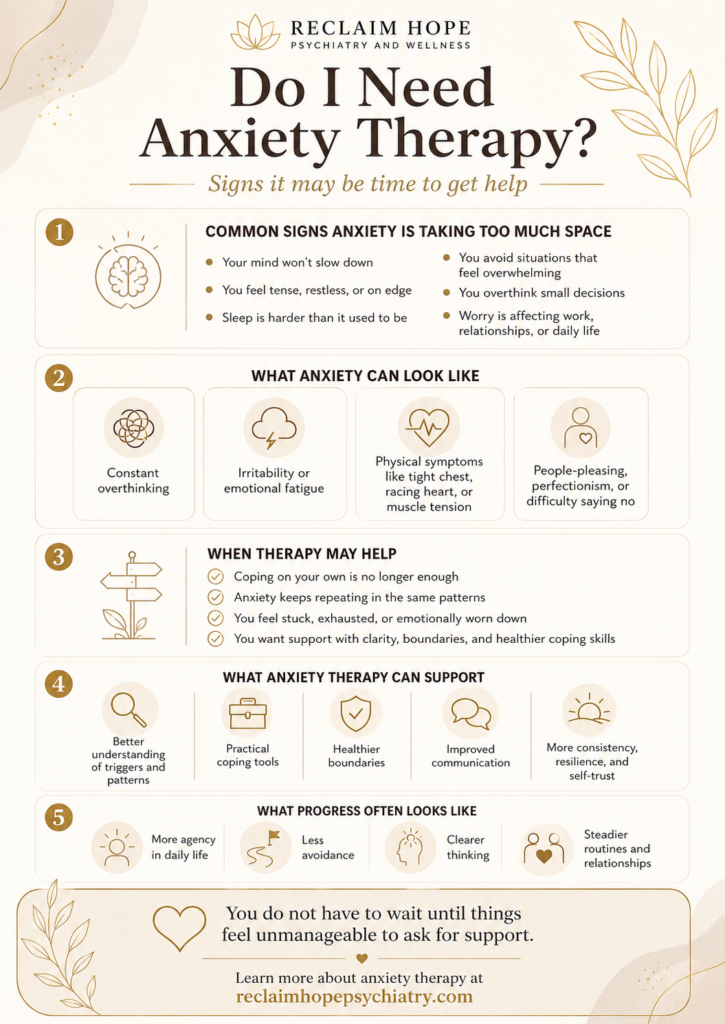
What Anxiety Can Start to Look Like Over Time
Anxiety does not always look like panic. Sometimes it looks like being unable to stop planning for the worst. Sometimes it looks like needing constant reassurance. Sometimes it shows up as procrastination, perfectionism, avoidance, people-pleasing, or difficulty saying no.
I often notice that people describe anxiety in practical terms before emotional ones. They may say:
“I can’t shut my mind off.”
This is one of the most common things I hear. The mind keeps reviewing conversations, predicting problems, or creating backup plans. Even when the person knows the thoughts are excessive, the body still reacts as if there is something urgent to solve.
“I avoid things that used to feel normal.”
Avoidance can be subtle. You may delay making phone calls, stop driving certain routes, avoid social situations, put off medical appointments, or stay quiet in conversations because speaking up feels too uncomfortable.
Avoidance can bring short-term relief, but over time it often makes anxiety smaller in one moment and larger in the overall pattern.
“I feel responsible for everyone’s comfort.”
Some people with anxiety are very tuned in to others. They notice tone changes, facial expressions, pauses in text messages, and small shifts in energy. This can come from many life experiences, including past stress, trauma, family dynamics, or years of trying to keep the peace.
Therapy can help sort out what is yours to carry and what is not.
“My body feels like it is always on.”
Anxiety is not only mental. It can affect sleep, digestion, breathing, muscle tension, focus, and energy. Many people do not realize how much effort their nervous system has been using until they begin to feel even small moments of relief.
There Is No One Best Type of Anxiety Therapy for Everyone
There are several evidence-based approaches that can help with anxiety, and no single method is right for every person. Cognitive behavioral therapy can help identify patterns in thinking and behavior. Psychodynamic therapy may help explore the deeper roots of fear, responsibility, or self-protection. EMDR can be helpful when anxiety connects to trauma or distressing memories. Other approaches may focus more on nervous system regulation, communication, or daily coping skills.
In my work, I do not see these as competing ideas as much as different tools. The important question is not only, “Which therapy method is best?” It is also, “What does this person need in order to feel more honest, steady, and capable in daily life?”
Good therapy should not feel like a script being applied to you. It should feel like a thoughtful process that considers your history, your current stressors, your relationships, your responsibilities, and the way anxiety is actually showing up in your life.
That is one reason I believe the relationship between therapist and client matters. People need room to speak openly, but they also need structure. They need compassion, but not avoidance of the hard parts. They need support, but they also need help noticing where patterns continue.
When Anxiety Therapy Starts Becoming Useful in Real Life
Therapy is not only about understanding anxiety. Understanding is important, but it is not the whole process. I have worked with many people who understand their anxiety very well and still feel stuck in it.
What often makes therapy effective is the combination of insight and practice.
Structure
Anxiety can make life feel scattered. Therapy gives the work a place to go. There is time set aside to slow down, look at what is happening, and name patterns that may be hard to see when you are in the middle of them.
Structure can also help reduce the sense that everything needs to be solved at once. In therapy, we can begin with what is most urgent, then gradually work toward deeper patterns.
Boundaries
Boundaries are a major part of anxiety work. Many people with anxiety have become used to overextending themselves. They answer quickly, explain too much, say yes when they are already depleted, or take responsibility for how others react.
In therapy, boundaries are not treated as harsh or selfish. They are treated as part of emotional health. A boundary may sound simple, but for someone who has lived with chronic worry or guilt, it can take real practice.
Responsibility
This part can be uncomfortable, but it is important. Therapy is not about blaming you for anxiety. It is also not about pretending you have no role in changing the patterns around it.
Responsibility means learning where you have choices. It may mean noticing when reassurance-seeking is keeping worry alive. It may mean practicing direct communication instead of withdrawing. It may mean slowly facing situations you have avoided. It may mean caring for your body more consistently, even when anxiety tells you there is no time.
The goal is not perfection. It is participation.
Behavioral Change
Anxiety often improves when the pattern changes, not just when the feeling is discussed. This can include sleep routines, boundaries with work, reducing avoidance, practicing grounding skills, making decisions with less checking, or having conversations that have been delayed.
These changes are usually not dramatic at first. They are often small, repeated choices. But repeated choices matter.
Consistency
I have learned that consistency is one of the quieter strengths in therapy. It is not always exciting. It does not always feel like a breakthrough. But showing up regularly, reflecting honestly, and practicing between sessions can begin to create a different relationship with anxiety.
Consistency helps people learn that they can feel anxious and still act with care, clarity, and responsibility.
For many clients, individual therapy becomes the place where this kind of steady work can happen without needing to perform, minimize, or explain everything perfectly.
Signs It May Be Time to Get Help
There is no exact line you have to cross before therapy is allowed. Still, there are signs I would take seriously.
It may be time to consider therapy if anxiety is affecting your sleep, relationships, work, parenting, decision-making, or ability to rest. It may also be time if you feel emotionally reactive more often than you want to, or if you are avoiding parts of life because the discomfort feels too high.
Another sign is when your coping strategies are no longer helping. Many people develop ways to manage anxiety that make sense at first. They stay busy. They control details. They overprepare. They avoid conflict. They try to be needed. They push through.
These strategies may have helped at one point. But over time, they can become limiting.
Therapy can help you look at those patterns with honesty and care. Not shame. Not judgment. Just a clearer understanding of what is working, what is costing you, and what needs to change.
What Begins to Change When Therapy Is Working
When therapy is working, people do not always describe it as feeling happy all the time. More often, they describe subtle shifts.
They may pause before reacting. They may notice anxiety sooner. They may communicate more directly. They may stop apologizing for reasonable needs. They may begin to trust themselves with decisions that used to feel overwhelming.
I often see people develop more agency. They begin to understand that anxiety may show up, but it does not have to lead every choice. That is an important shift.
Daily routines may also become more stable. Sleep may improve. Mornings may feel less rushed. Work may feel more manageable. Relationships may become less dependent on guessing what others think.
Clarity is another change. Anxiety tends to blur everything together. Therapy helps separate what is urgent from what is uncomfortable, what is yours from what belongs to someone else, and what needs action from what needs acceptance.
These are not small things. They affect how a person moves through the day.
Accountability Is Part of the Work
Accountability in therapy is not punishment. It is support with honesty.
In my experience, people often need someone who can listen with compassion while also helping them stay connected to their own growth. It is easy to talk about change. It is harder to practice it when life gets stressful, when old patterns feel familiar, or when setting a boundary creates discomfort.
Therapy can help you keep returning to the work. What did you notice this week? Where did anxiety take over? Where did you choose differently? What felt possible, and what still felt too hard?
This kind of accountability builds resilience. Not the kind that means enduring everything quietly. I mean the kind of resilience that helps you respond to life with more steadiness, more self-respect, and more capacity to repair when things do not go well.
Anxiety therapy is not usually about removing every anxious feeling. It is about changing your relationship with anxiety so it no longer controls as much of your life.
That process takes time. It also takes honesty. But it can be deeply worthwhile.
Suggested Featured Image
A calm, light-filled therapy office with two comfortable chairs, soft neutral decor, and a warm luxury feel. The image should feel private, grounded, and professional, with no text on the image.
Taking the Next Step
I am grateful when someone reaches the point of asking whether they need help, because that question often carries more courage than people realize. It means some part of you is paying attention. It means you may be ready to stop managing everything alone.
If anxiety has been shaping your days, your relationships, or the way you see yourself, anxiety therapy can offer a steadier place to begin. At Reclaim Hope Psychiatry and Wellness, the work is approached with care, consistency, and respect for the pace of real change.
When you are ready, you can reach out to Reclaim Hope Psychiatry and Wellness to start the conversation.