


If you’re wondering whether depression treatment without medication is possible, the short answer is: sometimes, yes. The longer answer is that it depends on many factors, including the severity of your symptoms, how long they’ve been present, and what’s driving them in the first place. As a psychiatric provider, I want to give you an honest look at what the evidence actually says, because this is one of the most common questions I hear, and it deserves a thoughtful response rather than a simple yes or no.
Key Takeaways
- Depression exists on a spectrum, and treatment decisions should match the severity and nature of your symptoms.
- Non-medication approaches like psychotherapy, lifestyle changes, and behavioral interventions have real clinical evidence behind them, particularly for milder presentations.
- Medication is often recommended when depression is moderate to severe, persistent, or significantly impairing daily functioning.
- A thorough psychiatric evaluation is the best way to figure out which approach, or combination of approaches, makes sense for you.
- Non-medication and medication-based treatments are not opposites. They frequently work best together.
What Does “Treating Depression Without Medication” Actually Mean?
When people ask this question, they’re usually coming from one of a few places. Some have tried antidepressants and didn’t like the side effects. Some are newly diagnosed and want to start with the least invasive option. Some have philosophical reservations about psychiatric medication. All of those perspectives are understandable, and none of them are wrong to have.
But it’s worth clarifying what we’re actually talking about when we say “treatment.” Treatment means something that has demonstrated effectiveness in reducing depressive symptoms and improving quality of life. That matters because not everything marketed as a depression solution meets that bar.
Non-medication treatments with genuine clinical support include:
- Psychotherapy, particularly cognitive behavioral therapy (CBT) and behavioral activation, which help people identify patterns of thinking and behavior that maintain depressive episodes.
- Exercise, which has meaningful evidence behind it, especially for mild to moderate depression. Consistent aerobic activity can influence the same neurobiological systems that medications target.
- Sleep regulation, since disrupted sleep both causes and worsens depression, and improving sleep hygiene can reduce symptom burden meaningfully.
- Social connection and structured routine, which counteract the withdrawal and isolation that depression tends to reinforce.
- Mindfulness-based approaches, including mindfulness-based cognitive therapy (MBCT), which has strong evidence for preventing depressive relapse in people with recurrent episodes.
These are not soft suggestions. They are real interventions with real effects. The question is whether they’re sufficient on their own for a given person at a given point in time.

When Medication Becomes Part of the Picture
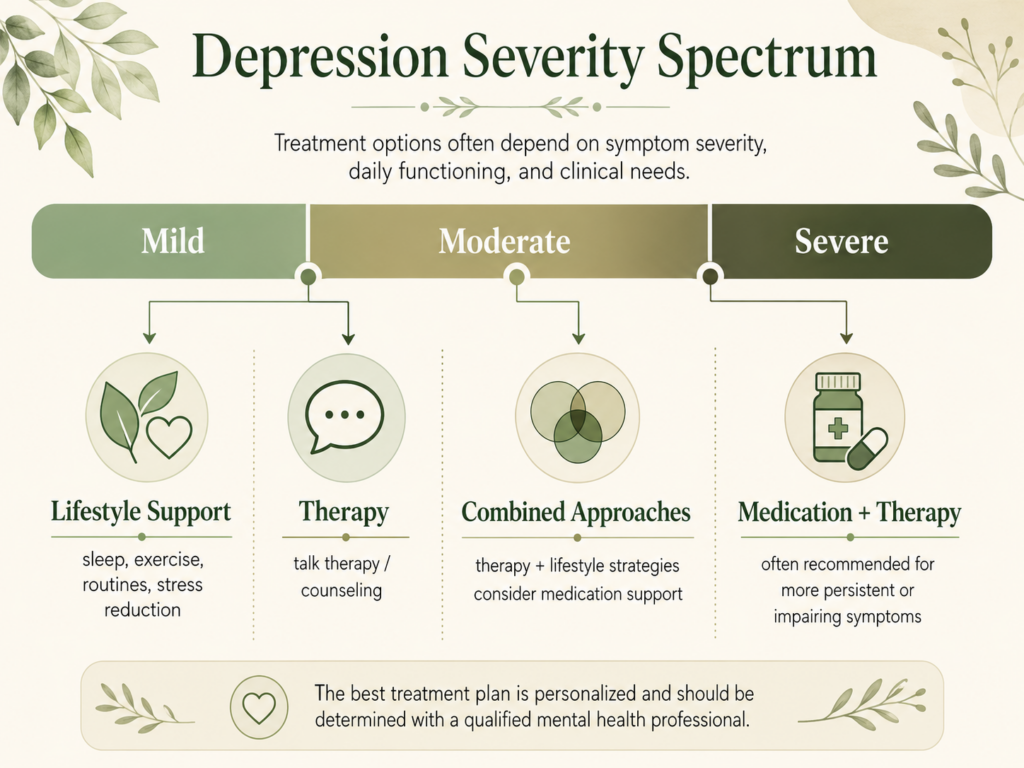
There’s a meaningful difference between mild and moderate-to-severe depression, and that distinction matters enormously when we’re thinking about treatment.
For milder presentations, sometimes called dysthymia or persistent depressive disorder, psychotherapy alone is often a reasonable first step. I’ve worked with patients who made significant progress through structured therapy, particularly when they had good insight into their patterns, a stable support system, and the capacity to engage actively in the therapeutic work.
But when depression is moderate to severe, when it’s interfering with someone’s ability to work, care for themselves, maintain relationships, or when passive thoughts of death are present, waiting to see if lifestyle changes are enough is not a clinically sound approach. Antidepressants, mood stabilizers, or other psychiatric medications are not a shortcut or a sign of weakness. They address underlying neurobiological processes that non-medication strategies simply cannot reach as efficiently.
Here’s a clinical example that comes up often. A patient comes in presenting with low mood, fatigue, and poor concentration. They’ve been this way for four to six months. They’re still functioning, but barely. We do a full evaluation and determine they’re experiencing a moderate depressive episode. In a case like that, I would typically discuss the evidence for both therapy and medication, explain that the research consistently shows better outcomes when both are combined, and let the patient lead the decision with full information in hand. That conversation is not about pushing medication. It’s about being honest about what the evidence supports.
Benefits of Exploring All Your Options
Taking a comprehensive approach to depression care, one that considers both medication and non-medication strategies, has several advantages:
- It allows for more personalized care that fits your values, history, and clinical picture.
- It reduces the risk of relying too heavily on any single intervention.
- It creates a more durable foundation for long-term mental wellness, not just symptom reduction in the short term.
- It gives you agency in your own care, which itself has a positive effect on outcomes.
“The goal isn’t to avoid medication or to rely solely on medication. The goal is to find the right combination of supports for your specific situation, and to keep adjusting as that situation changes.”
What a Psychiatric Evaluation Actually Looks Like
Understanding whether medication belongs in your treatment plan starts with a thorough evaluation. This isn’t a ten-minute questionnaire. A proper psychiatric evaluation involves a detailed conversation about your current symptoms, how long they’ve been present, what your mood history looks like over time, your family psychiatric history, any medical conditions that could be contributing, your sleep, appetite, energy, and concentration, and what you’ve already tried.
That information shapes everything. It tells me whether we’re looking at a depressive episode, a mood disorder with depressive features, a trauma response that presents like depression, or something else entirely. Each of those has different treatment implications. Two people who both say “I’m depressed” may need very different care.
The evaluation is also where we talk honestly about the role of individual therapy alongside whatever medication decisions we make. I refer patients to therapy regularly, not as an alternative to psychiatric care, but as a complement to it.
Finding the Approach That Fits You
Depression treatment without medication is a legitimate path for some people, particularly those with milder symptoms and strong motivation to engage in behavioral and therapeutic work. For others, especially those with more severe or persistent presentations, medication is not optional. It’s what makes recovery possible.
What I always tell patients is that this isn’t a permanent either/or decision. Someone might start with therapy alone, find that their symptoms aren’t improving enough after several months, and then add medication. Someone else might start with medication to get stabilized, then taper off under careful supervision once they’ve built strong coping skills through therapy. Treatment evolves.
If you’re unsure where you fall on that spectrum, the most useful thing you can do is get a thorough evaluation with a qualified psychiatric provider. That’s where clarity comes from. If you’re in Arizona and looking for that kind of honest, individualized assessment, I’d encourage you to schedule a psychiatric evaluation at Reclaim Hope Psychiatry and Wellness. We’ll look at the full picture together and figure out what actually makes sense for you.
Frequently Asked Questions
Is there a way out of depression without medication?
For some people, yes. Psychotherapy, particularly cognitive behavioral therapy, along with consistent exercise, sleep regulation, and social engagement, can be effective for mild to moderate depression. The key word is “for some people.” Severity matters. Duration matters. How much depression is impairing your life matters. A psychiatric evaluation can help determine whether a non-medication approach is appropriate, or whether medication would give you a better foundation to build on.
What is a mild form of depression?
Mild depression typically refers to a presentation where depressive symptoms are present but not severely impairing daily functioning. Someone with mild depression may feel persistently low, lose interest in activities they used to enjoy, and feel more fatigued than usual, but they’re still able to work, maintain relationships, and take care of basic responsibilities. Persistent depressive disorder, sometimes called dysthymia, is one diagnosis that fits this description. Mild depression is often more responsive to non-medication treatments than moderate or severe depression, though individual assessment is still essential.
What is the best treatment for mild depression?
Evidence supports psychotherapy, particularly cognitive behavioral therapy, as a first-line treatment for mild depression. Behavioral activation, which involves deliberately increasing engagement with meaningful activities, is also well-supported. Lifestyle factors like regular exercise, consistent sleep, and reduced alcohol use can make a meaningful difference at this level of severity. Whether or not to add medication is a decision made case by case. Some people with mild depression do respond well to antidepressants, especially when their symptoms have persisted for a long time without improvement.
How do you shower and take care of yourself when depressed?
This is a question more people ask than you might expect, and it’s worth taking seriously. Depression makes basic self-care genuinely harder, not because of a lack of willpower, but because the condition depletes motivation, energy, and the capacity to initiate tasks. Behavioral strategies that help include breaking tasks into smaller steps, setting a specific time rather than waiting until you “feel like it,” and linking a basic care task to something else that’s already happening in your day. These strategies are part of what behavioral activation addresses in therapy. If basic self-care has become difficult, that’s also a signal that your depression may be more than mild and that professional support is worth seeking sooner rather than later.
Can depression come back after stopping treatment?
Depressive episodes can recur, especially if underlying vulnerabilities haven’t been addressed or if treatment ends prematurely. Research shows that people with a history of multiple depressive episodes have a higher likelihood of future episodes, which is one reason why some individuals remain on maintenance medication for longer periods. Building durable coping skills through therapy, maintaining lifestyle habits that support mood stability, and staying in regular contact with your psychiatric provider are all part of reducing that risk. Any decision to taper or stop medication should always be made in close collaboration with your prescriber, never on your own.