

Anxiety is one of the most common reasons people reach out to a psychiatric provider, and honestly, one of the most treatable. But a lot of people spend months or even years trying to manage on their own before they ever consider seeing a psychiatrist for anxiety. That hesitation is understandable. Anxiety has a way of making everything feel uncertain, including the decision to ask for help. This article is here to cut through some of that fog and give you a clearer picture of when psychiatric care makes sense, what the process looks like, and what you can realistically expect.
Key Takeaways
- Persistent anxiety that disrupts daily life is a clinical concern, not a character flaw, and it responds well to proper psychiatric care.
- You can go directly to a psychiatrist without a referral from your primary care provider in most cases.
- A psychiatric evaluation for anxiety is a structured conversation, not a test you pass or fail.
- Medication is one tool among several, and when it is appropriate, choices are made carefully and collaboratively.
- Getting an evaluation does not obligate you to start medication. It just gives you more information.
What Anxiety Actually Looks Like as a Clinical Condition
Most people have felt anxious before a big presentation or during a difficult stretch of life. That kind of situational anxiety is a normal human experience. What I am talking about here is something more persistent and disruptive. An anxiety disorder is present when worry, fear, or physical symptoms of anxiety become difficult to control, are disproportionate to the situation, and interfere with how you function day to day.
Five symptoms that are commonly associated with anxiety disorders include:
- Excessive, hard-to-control worry that is present most days and touches multiple areas of life, such as work, relationships, or health.
- Physical symptoms like muscle tension, headaches, a racing heart, shortness of breath, or gastrointestinal discomfort that do not have a clear medical cause.
- Sleep difficulties, particularly trouble falling or staying asleep because your mind will not quiet down.
- Avoidance behaviors, where you start skipping situations, places, or conversations because of how they make you feel.
- Concentration problems, where anxiety pulls your attention away from tasks and makes it hard to be present.
Any one of these alone might have other explanations. But when several show up together and persist for weeks or months, that is when it is worth talking to a provider who can look at the full picture.
Can You Go Straight to a Psychiatrist for Anxiety?
Yes, and in many cases it is the most efficient path. You do not need a referral from a primary care provider to schedule a psychiatric evaluation at most practices, including ours. That said, if you have a good relationship with your primary care provider and they have already ruled out medical causes for your symptoms, that information is genuinely useful and worth sharing.
People sometimes assume a psychiatrist is only for the most severe cases. That is not how I think about it. A psychiatric provider brings specialized training in the neuroscience and pharmacology of mental health conditions. For anxiety specifically, that means I can think carefully about what type of anxiety you are experiencing, whether there are other conditions present, and what combination of treatment approaches makes sense for you specifically. A therapist is an excellent partner in that process, and therapy is often part of the plan, but a psychiatrist can offer something therapy alone cannot: an informed clinical assessment of whether medication might help and, if so, how to use it thoughtfully.
How a Psychiatric Evaluation for Anxiety Works
One of the most common questions I hear is how long it takes to get a diagnosis. The honest answer is that a single evaluation appointment is usually enough to arrive at a working clinical picture, though it is more of an ongoing conversation than a one-time verdict.
Here is roughly what to expect in that first visit:
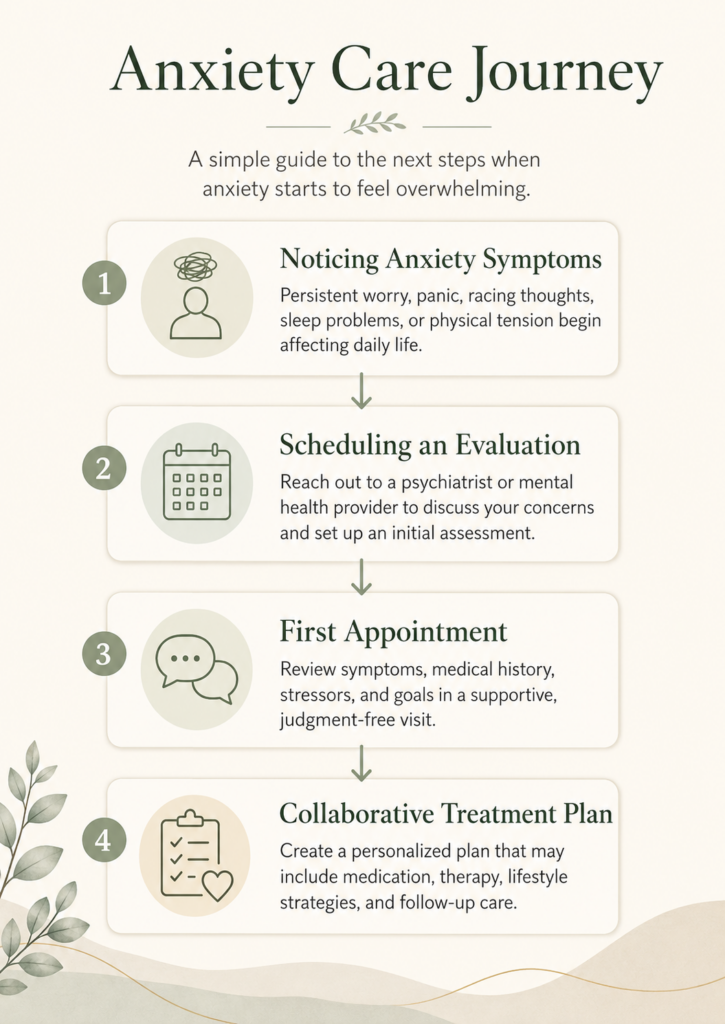
- Gathering your history. I want to understand when your anxiety started, what triggers it, how it has changed over time, and what you have already tried.
- Symptom exploration. We go through your current symptoms in some depth. I am looking at frequency, intensity, and how much they affect your functioning.
- Screening for other conditions. Anxiety frequently overlaps with depression, ADHD, OCD, and trauma histories. A thorough evaluation looks at the whole picture rather than focusing on a single label.
- Medical context. Certain thyroid conditions, cardiac issues, and other medical factors can look a lot like anxiety. If those have not been ruled out, that becomes part of the conversation.
- Collaborative discussion. At the end of the evaluation, we talk through what I am seeing and what options might make sense. That includes both therapy-based approaches and whether medication is worth considering.
The evaluation itself does not tell you what you have to do. It tells you what is going on and opens up a real conversation about how to address it.
The Role of Medication in Anxiety Treatment
Medication is not right for everyone with anxiety, and I would never frame it that way. But for many people, it is a meaningful part of care. When anxiety is severe enough that it is difficult to engage meaningfully in therapy, when symptoms have been present for a long time without relief, or when the anxiety is significantly affecting quality of life, medication can shift things enough to make other work possible.
In general, the medications most commonly used for anxiety disorders fall into a few categories: antidepressants that work on serotonin or norepinephrine systems, certain antianxiety medications intended for short-term or situational use, and in some cases, other agents chosen based on specific symptom profiles. Every decision about medication is individualized. We talk through your health history, any prior medication experiences, your concerns, and your goals before any prescription is written.
Medication is not a shortcut, and it is not a substitute for understanding yourself. When it works, it tends to create the conditions where doing the harder work becomes more possible.
Monitoring matters just as much as the initial choice. Medication management is not a set-it-and-forget-it process. We check in regularly, adjust as needed, and pay attention to how you are tolerating whatever we try. Explore the full range of psychiatric services we offer to understand how evaluation, medication management, and ongoing care fit together.
Are You Having a Mental Health Crisis?
It is worth naming this directly. Some people come to a psychiatric evaluation not just because anxiety has been building slowly, but because something has shifted recently and they are struggling in a more acute way. Panic attacks that feel like heart attacks, anxiety so severe you cannot leave the house, or a sense that things are completely out of control: these are situations where reaching out sooner rather than later makes a real difference.
A mental health crisis does not always look dramatic from the outside. Sometimes it is quiet. It can feel like going through the motions while barely holding it together. If that resonates, please do not wait for things to get worse before reaching out. Psychiatric care exists precisely for that in-between space where things feel unsustainable but you are not sure it rises to the level of an emergency.
Taking the Next Step
If you have been living with anxiety that feels bigger than you can manage on your own, a psychiatric evaluation is a reasonable and practical place to start. It is not a commitment to a particular treatment path. It is a conversation with someone trained to help you make sense of what is happening and figure out what might actually help.
Seeking care for anxiety is not dramatic. It is not an overreaction. It is one of the more sensible things you can do when something is getting in the way of the life you want to be living.
If you are ready to take that step, I would encourage you to schedule a psychiatric evaluation with Reclaim Hope Psychiatry and Wellness. We will start where you are, move at a pace that feels right, and work together toward something more sustainable.
Frequently Asked Questions
Can I go straight to a psychiatrist for anxiety?
Yes. In most cases you do not need a referral. You can contact a psychiatric practice directly and schedule an evaluation. If you have seen your primary care provider about your symptoms and they have done any relevant lab work or ruled out medical causes, bring that information along. It helps, but it is not a prerequisite.
What are 5 symptoms of anxiety disorder?
The most common ones I see are excessive worry that is hard to control, physical symptoms like muscle tension and a racing heart, sleep problems related to an overactive mind, avoidance of situations that trigger anxiety, and difficulty concentrating. These symptoms vary in how they show up for different people, which is part of why a proper evaluation is so useful.
Am I having a mental health crisis?
A crisis does not always mean an emergency. It can mean that anxiety has become so disruptive that functioning day to day feels barely possible. Frequent panic attacks, inability to leave home, or a pervasive sense of dread that is not letting up are all signs that something needs attention sooner rather than later. If you are uncertain, reach out. Erring on the side of getting evaluated is always the safer choice.
How long does it take a psychiatrist to diagnose anxiety?
A single evaluation appointment is usually enough to arrive at a working clinical picture. That first visit typically runs between 60 and 90 minutes and covers your symptom history, current functioning, medical context, and any other conditions that might be part of the picture. The diagnosis is a starting point for a collaborative conversation, not a final verdict.
What is the difference between a psychiatrist and a therapist for anxiety treatment?
A therapist focuses on evidence-based talk therapy approaches to help you understand and change patterns of thinking and behavior. A psychiatric provider brings clinical training in evaluation, diagnosis, and medication management. For anxiety, both have important roles, and they work best together. In a psychiatric evaluation, we often discuss therapy as part of the overall plan, and many people benefit from both.